 HockeySize
 Skates are the piece people most often get wrong, and the mistake is nearly always the same: buying them like shoes. A hockey skate should hold the heel locked and the toes just brushing the cap, with no room to grow. Here is how to get there.
Start from your shoe size, then go down
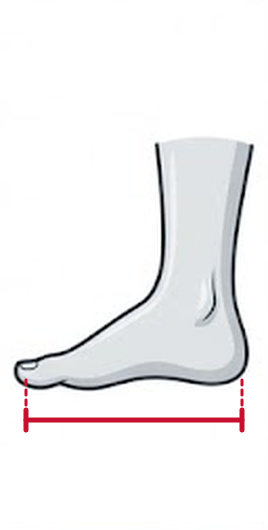
Hockey skates run smaller than shoes. For men’s US shoe sizes, the skate is usually 1 to 1.5 sizes smaller; for women’s US sizes, about 2.5 to 3 sizes smaller. CCM publishes an exact conversion table, and Bauer’s guidance is the same minus-1.5 rule. The finder applies these for you.
The fit tests
- Toe touch. Standing straight with the skate laced, the toes should lightly feather the toe cap. Bend the knees into a skating stance and they should pull back a few millimetres. If they touch hard in a stance, go up half a size; if there is space in a stance, go down.
- Heel lock. With the skate laced, the heel should not lift when you rise onto your toes. Heel lift means the boot is too long or the wrong fit profile.
- Pencil test. Lay a pencil across the eyelets at the top of the boot. If it rests on both sides without touching the foot, the boot has the right depth. If the foot pushes it up, you need a higher-volume fit.
Width and fit profiles
Length is only half the job. Bauer now sells its skates in Fit 1, Fit 2 and Fit 3: Fit 1 is the narrowest and lowest-volume, Fit 2 the middle (roughly the old D width), Fit 3 the widest and deepest (roughly the old EE). CCM uses regular, tapered and wide on its senior lines. If your feet are wide or high-arched, choosing the right profile matters more than the half size.
Kids: no room to grow
It is tempting to buy a size up for a growing child, but a loose skate is slow, tiring and unsafe, and the child will skate worse in it. Buy the correct size and expect to replace youth skates roughly once a season. Good used skates are fine here; the boot outlasts a child’s foot.
Heat moulding
Most mid-range and higher skates can be baked at the shop, which softens the boot so it forms to your foot. It improves heel lock and removes pressure points; it does not change the length, so size correctly first.
Common mistakes
- Sizing by shoe size without converting.
- Choosing a wide fit because the length felt tight, when the length was simply too short.
- Judging fit with thick socks. Skate in thin socks and try them on the same way.
- Skipping the first sharpening. New skates are not sharp; see the sharpening guide.